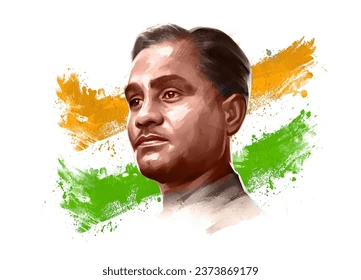
The wizard of hockey often left people struck with wonder as to how he played so well, enough to make officials break his stick to check for foul play.
Major Dhyan Chand, is regarded as one of the greatest players in the field of hockey. He was an Indian Hockey player and was widely known for his goal scoring feats. He won three Olympic Gold Medals in 1928, 1932 and 1936, at a time when India was dominating the Olympics in field hockey.
He joined the Army at the tender age of 17 and was selected to play for the forces that same year. His excellent dribbling skills got him selected for the New Zealand tour in 1926 where the team won 18 out of 21 matches. India made their Olympic debut in 1928 in hockey under Dhyan Chand’s leadership. They won the gold medal with the Major scoring 14 goals. India won the Olympic gold again in 1932, winning against the hosts 24-1, where Major Dhyan Chand scored 12 goals.
The 1936 Olympics were a milestone in his career. He leads the team to victory against Germany (8-1), after getting defeated by them in the warm-up matches. Hitler even asked him to play for Germany, an offer which the Major declined.
His superior dribbling skills and exceptional control over the ball made him one of the greatest players of all time.
His exceptional skills made officials check Dhyan Chand’s hockey stick
“The Olympic complex now has a magic show too.” was the headline of a German newspaper. Soon after that Berlin was set up with posters everywhere saying “Visit the hockey stadium to watch the Indian magician Dhyan Chand in action.”
Such were his skills that during one of the matches in Netherlands, it was reported that the officials broke his stick to check if there was a magnet inside. Officials in Tokyo were also reported to break his stick to check if there was any sign of foul play.
In 1951, Captain Dhyan Chand was honoured at the National Stadium with the Dhyan Chand tournament. He retired at the age of 51 in 1956, from the Army with the rank of Major. The government awarded him with the Padma Bhushan, the third-highest civilian award, in 1956. He remains the only hockey player to receive such honour.
India’s highest award for lifetime achievement in sports is termed after him. Since 2002, the Dhyan Chand award is given to sportspeople who contribute to the sport, especially after retirement, and his great legacy lives on.
In the 1928 Amsterdam Summer Olympics, the Indian team was put in the division A table, with Austria, Belgium, Denmark and Switzerland. On 17 May the Indian national hockey team made its Olympic debut against Austria, winning 6–0, with Chand scoring 3 goals. The next day India defeated Belgium 9–0; however, Chand only scored once. On 20 May, Denmark lost to India 5–0, with Chand netting 3. Two days later, he scored 4 goals when India defeated Switzerland 6–0.
The final match took place on 26 May, with India facing the home team of the Netherlands. The Indian team’s better players Feroze Khan, Ali Shaukat and Kher Singh were on the sick list and Chand himself was ill. However, even with a skeletal side, India managed to defeat the hosts 3–0 (with Singh scoring 2), and the Indian team won its country’s first Olympic gold medal. Chand was the top scorer of the tournament, with 14 goals in 5 matches. A newspaper report about India’s triumph said:
This is not a game of hockey, but magic. Dhyan Chand is in fact the magician of hockey.
Later, the authorities in the Netherlands in fact broke Chand’s hockey stick to check if there was any magnet inside owing to his superb ball control ability. An elderly woman asked him to play with her walking cane and he continued to score goals with it.
On returning to India, the team was received by thousands of people at the Bombay harbour, compared to the three people who had seen them off.
Posted in Waziristan in the North-West Frontier Province (now in Pakistan) with his new 2/14 Punjab Regiment, Chand, by now a naik (corporal) was cut off from the IHF, which was by now controlled by civilians. The Inter-Provincial Tournament was being held to select the new Olympic team; the IHF wrote to the Army Sports Control Board to grant Singh leaves to participate in the nationals. His platoon refused. Chand received news that he had been selected by the IHF for the Olympic team without any formalities. The rest of his teammates, however, had to prove their skills in the Inter-Provincial Tournament, which was won by Punjab. As such, seven players from Punjab were selected for the Olympic team. Apart from Chand, Broome Eric Pinnigar, Leslie Hammond and Richard Allen were the other 1928 Olympians retained in the team. Chand’s brother Roop Singh was also included in the squad as a left-in. Lal Shah Bokhari was selected as captain.
The Olympic team then played practice matches in India before heading for Colombo. In two matches in Ceylon, the Olympic team beat the All Ceylon XI 20–0 and 10–0. Wrote one newspaper on the first match, “Perfection is perilous, for it tempts the gods. For once, this was proved wrong for even the god of weather paid tribute to the genius of the Indian players. Rain clouds, which had threatened to ruin the game, vanished into the blue, and thousands of spectators spent a happy hour marveling at the incomparable artistry of the Indian team.”
The India team set sail for San Francisco on 30 May and arrived on 6 July. They reached Los Angeles three weeks before the opening ceremony of the Olympics, which took place on 30 July. On 4 August 1932, India played its first match against Japan and won 11–1. Chand, Roop Singh, Gurmit Singh each scored thrice, and Dickie Carr once. In the final on 11 August, India played against hosts USA. India won 24–1, a world record at that time (until it was broken in 2003), and once again clinched the gold medal. Chand scored 8 times, Roop Singh 10, Gurmit Singh 5, and Pinniger once. In fact, Chand along with his brother Roop scored 25 out of the 35 goals scored by India. This led to them being dubbed the ‘hockey twins’.
One Los Angeles newspaper wrote, “The All-India field hockey team which G. D. Sondhi brought to Los Angeles to defend their 1928 Olympic title, was like a typhoon out of the east. They trampled under their feet and all but shoved out of the Olympic stadium the eleven players representing the United States.”
The team then embarked on a tour of the United States. They played a match on 20 August against a United States XI, almost the same team that they had faced in Los Angeles. Even after loaning its second keeper Arthur Hind, for a half, the team won 24–1.
After setting sail from New York, the team arrived in England. They then embarked on a hectic tour, playing nine matches in various countries in a fortnight, commencing on 2 September. They played four internationals against the Netherlands, Germany, Czechoslovakia, and Hungary. The team then reached Sri Lanka and India, playing a number of matches to pay for their expenses. At the end of the tour, India had played 37 matches, winning 34, drawing 2, with one abandoned. Chand scored 133 of the 338 Indian goals.
In India, he is often referred to as Hockey ka Jaadugar which translates to “Magician of the game of Hockey”.

Leave a Reply